The digital revolution has transformed how we learn, work, and prove our expertise. Credential portability is now essential for career mobility and lifelong learning success. 🚀

The New Currency of Professional Identity
In today’s rapidly evolving workforce, traditional credentials like diplomas and certificates are no longer confined to physical documents tucked away in filing cabinets. The digital age has ushered in a paradigm shift where professional qualifications, skills, and achievements must be accessible, verifiable, and transferable across borders, industries, and platforms. This transformation represents more than a technological upgrade—it’s a fundamental reimagining of how we document and validate human capital.
Credential portability refers to the ability to carry your verified qualifications, skills, and achievements across different contexts, institutions, and geographic boundaries. Recognition, meanwhile, ensures these credentials maintain their value and legitimacy wherever they’re presented. Together, these concepts form the foundation of modern career development, enabling professionals to unlock opportunities that would have been impossible just a decade ago.
Why Traditional Credentials Fall Short Today
The limitations of conventional credentialing systems have become increasingly apparent in our interconnected world. Paper-based certificates can be lost, damaged, or forged. Verification processes often take weeks or months, creating bottlenecks in hiring and enrollment decisions. Perhaps most critically, traditional credentials frequently fail to translate across institutional or national boundaries, leaving professionals unable to leverage their hard-earned qualifications when they need them most.
Consider an engineer trained in Brazil seeking employment in Germany, or a nurse from the Philippines wanting to practice in Canada. Despite possessing genuine expertise and legitimate credentials, these professionals often face months of bureaucratic hurdles, redundant assessments, and sometimes complete credential dismissal. This inefficiency doesn’t just frustrate individuals—it deprives organizations and economies of valuable talent.
The Verification Challenge
Employers and educational institutions waste countless hours verifying credentials through manual processes. Phone calls to previous institutions, waiting for official transcripts, and cross-referencing databases create administrative burdens that slow decision-making and increase costs. In some cases, institutions no longer exist or have changed systems, making verification impossible. These friction points highlight why digital, portable credentials have become not just convenient but necessary.
Digital Credentials: Building Blocks of Career Mobility
Digital credentials represent a technological leap forward in how we document learning and achievement. Unlike their physical predecessors, digital badges, blockchain-verified certificates, and comprehensive learner records travel with individuals throughout their careers, instantly verifiable and impossible to falsify. These credentials contain rich metadata describing exactly what skills or knowledge the holder possesses, who issued the credential, and when it was earned.
The architecture behind modern digital credentials typically employs several key technologies:
- Blockchain verification: Creating immutable records that cannot be altered or forged
- Open standards: Ensuring credentials work across different platforms and systems
- Rich metadata: Providing detailed information about what the credential represents
- Privacy controls: Allowing individuals to share credentials selectively and securely
- Interoperability: Enabling credentials to be recognized across institutions and borders
This technological foundation transforms credentials from static documents into dynamic, actionable records that tell the complete story of a person’s learning journey and professional development.
Breaking Down Geographic and Institutional Barriers 🌍
Perhaps the most transformative aspect of portable credentials is their ability to transcend geographic boundaries. International talent mobility has become a strategic imperative for both individuals and organizations, yet credential recognition remains one of the most significant barriers. Portable digital credentials paired with international recognition frameworks are beginning to dissolve these obstacles.
The European Union’s Bologna Process demonstrated how multilateral agreements could facilitate credential recognition across countries. Digital credential systems build on this foundation, automating recognition through pre-established equivalencies and transparent competency mappings. When a credential is issued according to recognized standards and contains comprehensive metadata, receiving institutions can instantly understand its value without lengthy manual reviews.
The Economic Impact of Credential Recognition
Research consistently shows that effective credential recognition generates substantial economic benefits. Immigrants with recognized credentials earn significantly more than those whose qualifications go unrecognized. Organizations gain access to broader talent pools, reducing skills shortages. Economies benefit from fully utilized human capital rather than underemployment of qualified professionals working below their skill level.
A study by the World Education Services found that credential recognition gaps cost the Canadian economy billions annually in lost productivity and tax revenue. Similar patterns emerge globally, suggesting that improving credential portability and recognition isn’t just an educational issue—it’s an economic imperative with implications for competitiveness, innovation, and social mobility.
Lifelong Learning and Stackable Credentials
The traditional model of front-loaded education—completing all formal learning early in life—no longer serves the needs of modern careers. Technology evolves rapidly, job requirements shift constantly, and career paths zigzag across industries. This reality demands continuous learning throughout one’s professional life, but only if that learning can be efficiently documented and recognized.
Portable credentials enable the concept of stackable qualifications, where learners accumulate skills and knowledge incrementally over time. A professional might complete a micro-credential in data analytics, add a certification in project management, stack on a digital badge for leadership development, and eventually combine these into a recognized degree or advanced credential. Each component remains independently valuable while contributing to larger qualification frameworks.
This flexibility particularly benefits non-traditional learners: working adults who cannot commit to full-time study, individuals transitioning between careers, and those seeking to upskill without starting from scratch. Portable credentials make every learning experience count, regardless of where or how it occurs.
Empowering Learners With Ownership and Control 🎯
Traditional credentialing systems vest control with issuing institutions. Learners must repeatedly request transcripts, pay fees for verification, and depend on institutional responsiveness. Digital portable credentials flip this model, placing individuals at the center of their own credential ecosystem. Learners own their credentials, decide when and with whom to share them, and maintain access regardless of their relationship with the issuing institution.
This shift represents more than convenience—it’s a fundamental change in power dynamics. When professionals control their credentials, they can respond quickly to opportunities, curate portfolios that highlight relevant qualifications, and build comprehensive professional identities that span multiple institutions and experiences.
Privacy and Security Considerations
With ownership comes responsibility for privacy and security. Modern credential systems employ sophisticated encryption and selective disclosure technologies, allowing individuals to prove they possess a qualification without revealing unnecessary personal information. This balance between verification and privacy protection addresses legitimate concerns about data security while maintaining the integrity that makes credentials valuable.
Bridging Formal and Informal Learning
One of the most promising aspects of credential portability is its potential to recognize learning that occurs outside traditional educational institutions. Workplace training, community education, online courses, volunteer experiences, and self-directed learning all develop genuine skills and knowledge, yet these experiences have historically gone undocumented or unrecognized.
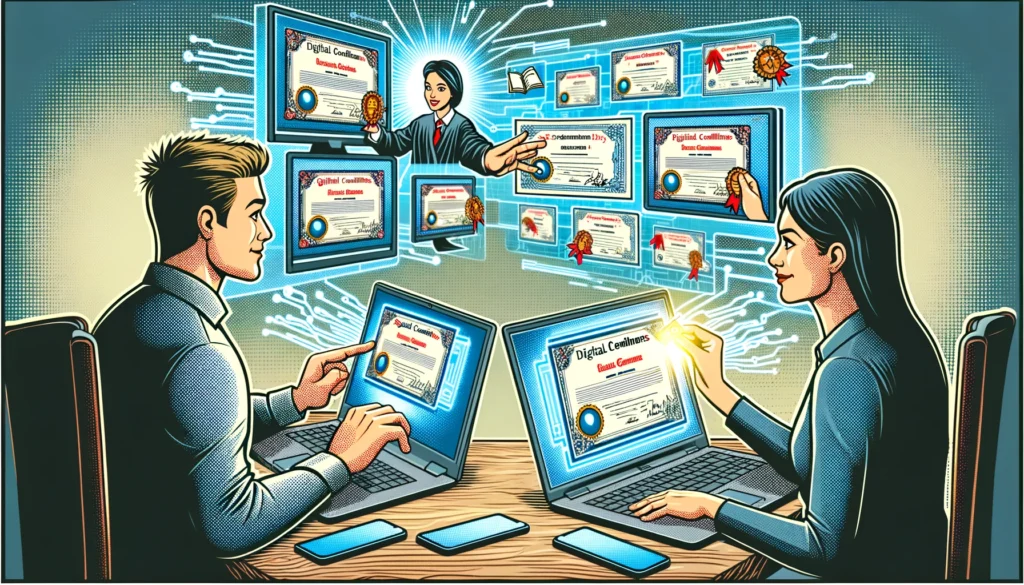
Digital credential ecosystems can capture and validate these diverse learning experiences, creating more complete pictures of individual capabilities. An employer-issued micro-credential for completing internal training becomes as verifiable and portable as a university degree. A badge earned through a massive open online course demonstrates specific competencies to potential employers. Volunteer work developing leadership skills receives formal recognition that contributes to career advancement.
This inclusivity democratizes opportunity by recognizing merit wherever it develops, rather than privileging only formal institutional pathways. For individuals without access to traditional education, portable credentials for alternative learning can become powerful tools for economic mobility.
Industry Applications and Real-World Success Stories
Various sectors have begun implementing portable credential systems with measurable success. Healthcare provides compelling examples, where credential verification directly impacts patient safety. Several nursing organizations now issue digital credentials that can be instantly verified across state lines, facilitating workforce mobility while maintaining quality standards. This system has proven particularly valuable during health emergencies when rapid credentialing of additional healthcare workers becomes critical.
The information technology sector has long embraced industry certifications, and many certification bodies now issue these as portable digital credentials. CompTIA, Cisco, Microsoft, and other major technology companies provide digital badges and certificates that professionals can share across platforms, building verified skill portfolios that employers trust.
Higher education institutions are increasingly adopting comprehensive learner record systems that document not just courses and grades but co-curricular activities, competencies, and projects. These rich records provide employers with much more meaningful information than traditional transcripts, while students benefit from credentials that better represent their full capabilities.
Challenges and Considerations for Widespread Adoption
Despite tremendous potential, several obstacles still hinder universal credential portability and recognition. Technical standards continue evolving, and not all systems interoperate seamlessly. Some institutions resist change, preferring familiar processes even when they’re inefficient. Quality assurance remains critical—portable credentials are only valuable if they represent genuine achievement and rigorous assessment.
Equity concerns also demand attention. Digital credentials require digital access, potentially excluding those without reliable internet connectivity or technological literacy. Implementation must consider these gaps to avoid creating new barriers while removing old ones. Additionally, the proliferation of credential issuers raises questions about which credentials carry weight and how stakeholders can efficiently assess credential quality.
Building Trust in Digital Credential Systems
Trust forms the foundation of any credentialing system. For portable digital credentials to achieve widespread acceptance, all stakeholders—learners, educators, employers, and regulators—must trust that credentials are issued based on legitimate achievement, cannot be falsified, and accurately represent the holder’s capabilities. This trust requires transparent governance, robust security measures, and accountability mechanisms that prevent credential fraud while protecting legitimate credential holders.
The Role of Emerging Technologies
Artificial intelligence and machine learning are beginning to enhance credential systems in fascinating ways. AI can help map credentials across different frameworks, identifying equivalencies that would take humans weeks to determine. Natural language processing can extract skill information from unstructured credential descriptions, making credentials more searchable and comparable. Predictive analytics might eventually help individuals identify which credentials will most effectively advance their specific career goals.
Blockchain technology has received considerable attention in the credentialing space, and for good reason. Its decentralized, tamper-proof architecture aligns well with the needs of credential systems. However, implementation must be thoughtful, balancing blockchain’s benefits against energy consumption concerns, complexity, and the need for systems that remain accessible to non-technical users.
Creating Pathways for Career Advancement and Economic Opportunity 💼
The ultimate promise of credential portability and recognition lies in unlocking human potential. When credentials travel with individuals and are universally recognized, people can pursue opportunities based on merit rather than being constrained by geography, institutional boundaries, or credential translation difficulties. This mobility benefits everyone: individuals access better opportunities, employers find qualified talent more easily, and societies leverage their full human capital.
For vulnerable populations—refugees, immigrants, individuals from disadvantaged backgrounds—portable credentials can be particularly transformative. A refugee who fled their country can still access verified records of their education and professional qualifications. An immigrant can demonstrate their skills earned abroad to employers in their new country. Someone who couldn’t afford traditional higher education can stack alternative credentials into meaningful qualifications that employers recognize.
These possibilities aren’t theoretical. They’re already materializing in early adopter institutions and forward-thinking organizations. As systems mature and adoption spreads, the impact will only grow, potentially reshaping how we think about education, work, and career development.
Moving Forward: Building the Infrastructure of Opportunity
Realizing the full potential of credential portability and recognition requires coordinated action across multiple fronts. Educational institutions must adopt open standards and implement systems that issue portable credentials. Employers need to develop capacity to receive, evaluate, and trust digital credentials. Policymakers should create regulatory frameworks that encourage innovation while maintaining quality standards. Technology providers must prioritize interoperability and user-centered design.
Most importantly, this transition must remain focused on the people it serves. Systems should be designed for learners and workers, not just institutional convenience. Accessibility, privacy, and equity must guide development at every stage. When credential systems truly serve their users, adoption will follow naturally as people experience tangible benefits in their educational and professional lives.
The journey toward universal credential portability and recognition is well underway but far from complete. Each organization that adopts portable credentials, each border that becomes easier to cross with verified qualifications, and each person who accesses opportunities previously beyond reach represents progress toward a more efficient, equitable, and opportunity-rich future. In the digital age, credentials should connect people to possibilities, not limit them. Portable, recognized credentials are the key that unlocks those doors. 🔑